|
Article
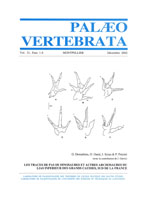
Les traces de pas de Dinosaures et autres Archosaures du Lias inférieur des grands Causses, Sud de la France
Published online: 15/12/2002
Keywords:
Dinosauroid footprints; France; Grands-Causses; Hettangian; ichnostratigraphy; paleoenvironments; Sinemurian; statistical results
https://doi.org/10.18563/pv.31.1-4.1-143
References: 165
Cited by: 24
Cite this article:
Georges Demathieu, Georges Gand, Jacques Sciau, Pierre Freytet and Jacques Garric, 2002. Les traces de pas de Dinosaures et autres Archosaures du Lias inférieur des grands Causses, Sud de la France. PalaeoVertebrata 31 (1-4): 1-143. doi: 10.18563/pv.31.1-4.1-143
Export citation
Abstract
The Causses" is a near 3400 km2 large plateau located in the south of France. Here the first dinosaur footprints where found in 1935. After this, this area has yielded an ever-increasing number of ichnites now in excess of 500 specimens. These latter, 15 to 50 cm long, tridactyl or tetradactyl footprints of generally biped animals, were discovered at the surface of Hettangian to lower Sinemurian dolomite layers within 4 distinct stratigraphic units. The 35 sites bearing ichnites are located on the plateau margin. For the first time, morphologic characters studied through descriptive statistic methods with the usual parameters and classical Student and Snédecor tests, allowed us, to divide the whole set of biped traces into 6 ichnospecies. Their definitions are further constrained by multivariate statistical results using Principal Component Analysis (PCA), Factor Analysis of correspondances (FAC) and Discriminant Analysis (DA). All have confirmed the morphologic observations. So that now, the following taxa are identified : Grallator variabilis, G. lescurei, G. sauclierensis, G. minusculus, Eubrontes giganteus, Dilophosauripus williamsi, cf. Moraesichnium, Orníthopus fabrei nov ichnosp. The more immediately visible differences relate to the interdigital II-IV divarication and the digit length ratio. To this panel, we must add Batrachopus deweyi and shapes suggesting Trisauropodichnus and/or Anomoepus. Among all ichnite associations described in the lower Liasic, the New England assemblage presents the most affinities with ours. It shows the ichnotaxa Grallator, Dilophosauripus, Eubrontes, Batrachopus without forgetting Ornithopus fabrei nov. ichnosp. which is close to Ornithopus gallinaceus from the Massachusetts and Connecticut basins. On comparing the present early Jurassic ichnofauna of the Causses with the ones of the Middle and Upper Triassic formations of the eastem border of the Massif Central (France), it appears that tridactyl footprints become more and more numerous and large from Triassic to Early Jurassic. In the Causses, these latest are prevalent but in Quercy (France), Poland, Italy, USA, they are also associated with Omithopoda, Thyreophora and Sauropoda ichnites. Footprint areas considered here were generaly under an arid climate. Animals that passed by were heavy and bulky possible Megalosaur trackmakers, and lighter and slender Coelophysids or Ceratosaurs. For all, these areas were pathways as the orientations of the trackways seem point out. The directions followed by these reptiles were without any important variation during the Hettango-Sinemurian stages. These areas were also used from time to time by Crocodilomorpha and may be tetradactyl (I-IV) bipedal avian Theropods. However, the number of such trackways in sites, sometimes substantial, should not lead us to overestimate the trackmakers populations. These last were probably relatively moderately abondant in this inter-supratidal swamp environment. In the Causses, ichnites are connected with former algo-laminated deposits (Algal mats) which were rapidly hardened by means of calcitisation of cyanobacteria. The result has been a moderate depth of footprints; autopodia disturbing only a few cm of the carbonate substrate. Other fossils have been discovered : invertebrates with thin bivalve and gastropod shells, crustaceans tests and plants. These latter suggest the existence of paleomangroves like environments but also continental vegetation periodically overruning the swamp environment during regression/transgression cycles. At these times, wooded parts of it, could become protecting, feeding, resting and nesting places.
Published in Vol. 31, Fasc. 1-4 (2002)
References
ALABOUVETTE, B., AUBAGNE, M., BAMBIER, A., FEIST, R. & PALOC, H., 1982. — Notice explicative de la feuille Lodève à 1/50.000. Bur. Rech. Géol. Min., Orléans-la-Source : 52 p.
ALABOUVETTE, B., BODEUR, Y., MATTEI, J., LOPEZ, M., RANÇON, J. P. & PALOC, H., 1987. — Carte géologique de la France à 1/50000, feuille du Caylar. Bur. Rech. Géol. Min., Orléans-la-Source.
ALABOUVETTE, B., ARRONDEAU, J.P., AUBAGUE, M., BODEUR, Y., DUBOIS, P., MATTEI, J., PALOC, H. & RANÇON, J. Ph., 1988. — Notice explicative de la carte géologique à 1/50 000 du Caylar. Bur. Rech. Géol. Min., Orléans-la-Source : 63 p.
ALEXANDER, R. M., 1976. — Estimates of speeds of dinosaurs. Nature, 261, 5556 : 129-130. https://doi.org/10.1038/261129a0
ANONYME, 1997. — Statistica : guide de l'utilisateur. StatSoft, Inc : 542 p.
ARRONDEAU, J.-P., 1982. — Etude sédimentologique du Lias inférieur carbonaté du seuil caussenard et de ses abords (Languedoc). Thèse 3ème cycle, Inst. Sc. Nat. Univ. de Nantes : 230 p., 128 fig., 11 pl.
AUBAGUE, M., LEFAVRAIS-RAYMOND, A., L'HOMER, A. & MICHARD, A.-G., 1979a. — La sédimentation liasique carbonatée du bassin caussenard. In la sédimentation du Jurassique W-Européen, Publ. sp. n° 1, Assoc. Séd. fr., 1 : 227-234, 2 fig.
AUBAGUE, M., LEFAVRAIS-RAYMOND, A., L'HOMER, A. & MICHARD, A.-G., 1979b. — Analyse de la sédimentation liasique carbonatée du bassin caussenard. In la sédimentation du Jurassique W-Européen, Publ. sp. n° 1, Assoc. Séd. fr., 1 : 235-245, 7 fig.
AVANZINI, M., 1995. — Impronte di sauropodi nel Giurassico inferiore del Becco di Filadonna (Piattaforma di Trento- Italia settentrionale). Studi Trentini Sc. Nat., Acta Geologica, 72 : 117-122, 8 fig.
AVANZINI, M., 1996. — Resti di vertebrati dal Giurassico inferiore della Piattaforma di Trento (Italia settentrionale). Nota preliminare. Studi Trentini Sc. Nat., Acta Geologica, 73 : 75-80, 3 fig.
AVANZINI, M., FRISIA, S., VAN DEN DRIESSCHE, K. & KEPPENS, E., 1997. — A Dinosaur Tracksite in an early Liassic Tidal Flat in Northern Italy: Paeoenvironmental Reconstruction from Sedimentology and Geochemistry. Soc. Sed. Geol., Research Reports : 538-551, 11 fig. https://doi.org/10.2307/3515410
AVANZINI, M., GIERLINSKI, G. & LEONARDI, G., 2001. — First report of sitting Anomoepus tracks in European Lower Jurassic (Lavini di Marco Site; Northern Italy). Riv. It. Paleont. Str., 107, 1 : 131-136, 2 fig.
AVANZINI, M., CEOLONI, P., CONTI, M. A., LEONARDI, G., MANNI, R., MARIOTTI, N., MIETTO, P., MURARO, C., NICOSIA, U., SACCHI, E., SANTI, G. & SPEZZAMONTE, M., 2001. — Permian and Triassic Tetrapod ichnofaunal units of northern Italy: their potential contribution to continental biochronology. Natura Bresciana Ann. Mus. Civ. Sc. Nat., Brescia : 25 : 89-107, fig. 4.
BALTZER, F., CONCHON, O., FREYTET, P. & PURSER, B. H., 1982. — Un complexe fluvio-deltaïque sursalé et son contexte : originalité du Mehran (SE de l'Iran). Mém. Soc. géol. Fr., N. S., 144 : 43-52.
BALTZER, F., KENIG, F., BOISCHARD, R., PLAZIAT, J.-C. & PURSER, B. H., 1994. — Organic matter distribution, water circulation and dolomitization beneath the Abu Dhabi Sabbkha (United Arab Emirates). Special Publ. Intern. Ass. Sediment., 21 : 409-427. https://doi.org/10.1002/9781444304077.ch23
BAIRD, D., 1957. — Triassic Reptile footprint faunules from Milford, New Jersey. Bull. Mus. of Comp. Zool., 117, 5 : 449-550, 9 fig., 2 pl., 3 tabl.
BESSONNAT, G., LAPPARENT (de) A. F., MONTENAT, C. & TERS, M., 1965. — Découverte de nombreuses empreintes de pas de Reptiles dans le Lias Inférieur de la Côte de Vendée. C. R. Acad. Sc., Paris, 260 : 5324-5326.
BRUN, P. (de) & MARCELLIN, P., 1934. — Etude stratigraphique des Petits Causses des environs de Florac (Lozère). Bull. Soc. Hist. nat. Toulouse, 76 : 377-489.
BUFFETAUT, E., 1995. — Dinosaures de France. Bur. Rech. Géol. Min., Orléans-la-Source : 144 p., 129 fig.
CARROL, R. L., 1988. — Vertebrate Paleontology and Evolution. W. H. Freeman & Company, New-York : 698 p., 1700 fig.
CASAMIQUELA, R. M., DEMATHIEU, G.R., HAUBOLD, H., LEONARDI, G. & SARJEANT, W.A.S., 1987. — Glossary and Manual of tetrapod footprint Palaeoichnology. Minist. min. energ., Léonardi édit., Brasilia : 75 p., 19 pl.
CHAFETZ, H. S. & BUCZYNSKI, C., 1992. — Bacterially induced lithification of microbial mats. Palaios, 7 : 277-293. https://doi.org/10.2307/3514973
CHAIGNEAU, A., 1965. — Indices et Empreintes du gibier. Crépin-Leblond et Cie édit. : 170 p., 72 fig., 22 tabl.
COUREL, L. & DEMATHIEU, G., 1976. — Une ichnofaune reptilienne, Ardèche, France. Palaeontographica, 151: 194-216, 8 fig., 4 pl., 7 tabl.
COUREL, L. & DEMATHIEU, G., 2000. — Une nouvelle ichnoespèce Coelurosaurichnus grancieri du Trias supérieur de l'Ardèche, France. Geodiversitas, 22, 1 : 35-45.
CZERKAS, S. J. & CZERKAS, S. A., 1990. — Les Dinosaures. Edit. Atlas, Paris : 247 p., 228 fig.
DALLA VECCHIA, F. M. & MIETTO, P., 1997. — Impronte di Rettili terrestri nella dolomia principale (Triassico superiore) delle Prealpi Carniche (Pordenone, Friuli). Atti Tic. Sc. Terra, 7 : 87-107, 11 fig.
DEMATHIEU, G., 1970. — Les empreintes de pas de vertébrés du Trias de la bordure N-E du Massif Central. Cahiers Paléont., éd. C.N.R.S., Paris: 291 p., 76 fig., 3 tabl., 8 pl.
DEMATHIEU, G., 1984. — Utilisation de lois de la Mécanique pour l'estimation de la vitesse de locomotion des Vertébrés tétrapodes du Passé. Geobios, 17, 4 : 439–446, 2 fig. https://doi.org/10.1016/S0016-6995(84)80018-2
DEMATHIEU, G., 1986. — Nouvelles recherches sur la vitesse des Vertébrés, auteurs des traces fossiles. Geobios, 19, 3 : 327–333, 1 fig., 1 tabl. https://doi.org/10.1016/S0016-6995(86)80021-3
DEMATHIEU, G., 1990. — Problems in discrimination of tridactyl dinosaur footprints, exemplified by the Hettangian trackways, The Causses, France. Ichnos, 1 : 97-110, 9 fig., 2 tabl. https://doi.org/10.1080/10420949009386339
DEMATHIEU, G., 1993. — Empreintes de pas de Dinosaures dans les Causses (France). Zubia, Inst. Est. Riojanos, 5 : 229-252, 24 fig.
DEMATHIEU, G., 1995. — Determining the speed of movement of the tetrapod vertebrates of the past by utilization of the laws of mechanics. In Vertebrates Fossils and the Evolution of Scientific Concepts, Gordon & Breach publ., USA : 445–459.
DEMATHIEU, G., 1996. — La pertinence des statistiques dans l'ichnotaxonomie des vertébrés. Bull. Soc. Hist. Nat. Autun, 160 (publié en 1998) : 13-26, 5 fig.
DEMATHIEU, G. & SCIAU, J., 1992. — Des pistes de dinosaures et de crocodiliens dans les dolomies de l'Hettangien du Causse du Larzac. C. R. Acad. des Sc., Paris : 315, II : 1561-1566, 3 fig.
DEMATHIEU, G. & SCIAU, J., 1994. — L'ichnofaune hettangienne d'Archosauriens de Sauclières, Aveyron, France. Bull. Soc. hist. Nat., Autun : 151 : 5-46, 18 fig., 3 tabl., 9 pl.
DEMATHIEU, G. & SCIAU, J., 1999. — De grandes empreintes de pas de Dinosaures dans l'Hettangien de Peyre (Aveyron, France). Geobios, 32, 4 : 609-616, 3 fig., 2 tabl. https://doi.org/10.1016/S0016-6995(99)80010-2
DOLLO, L., 1883. — Les allures des Iguanodons d'après les empreintes des pieds et de la queue. Bull. Mus. Roy. Hist. Nat. Belg., II : 14 p., 12 fig., 1 pl.
ELLENBERGER, F. & FUCHS, Y., 1965. — Sur la présence de pistes de vertébrés dans le Lotharingien de la région de Séverac-le-Château (Aveyron). C. R. sommaire Soc. géol. France : 39-40, 1 fig.
ELLENBERGER, F., ELLENBERGER, P. & GINSBURG, L., 1970. — Les Dinosaures du Trias et du Lias en France et en Afrique du Sud, d'après les pistes qu'ils ont laissées. Bull. Soc. géol. France, 7, 22 : 151-159, 3 fig. https://doi.org/10.2113/gssgfbull.S7-XII.1.151
ELLENBERGER, P., 1965. — Découvertes de pistes de vertébrés dans le Permien, le Trias et le Lias inférieur aux abords de Toulon (Var) et d'Anduze (Gard). C. R. Ac. des Sc. Paris, 260, 9 : 5856-5859.
ELLENBERGER, P., 1972. — Contribution à la classification des pistes de vertébrés du Trias : les types de Stormberg d'Afrique du Sud, 2ème partie : le Stormberg supérieur-I. Le biome de la zone B/1 ou niveau de Moyeni : ses biocénoses. Palaeovertebrata, Mémoire extraordinaire, Montpellier : 170 p., 143 fig., 28 pl. https://doi.org/10.18563/pv.5.ext
ELLENBERGER, P., 1974. — Contribution à la classification des pistes de vertébrés du Trias: les types de Stormberg d'Afrique du Sud (II ème partie : le Stormberg supérieur). Palaeovertebrata, Mémoire extraordinaire, Montpellier : 142 p., 49 pl. https://doi.org/10.18563/pv.6.ext
FARLOW, J. O., 1987. — Lower Cretaceous Dinosaur tracks, Paluxy River Valley, Texas, South Central. G. S. A. Baylor University : 70 p.
FARLOW, J. O., SMITH, M. B. & ROBINSON, J. M., 1995. — Body mass, "Strength indicator" and cursorial potential of Tyrannosaurus rex. Jour. Vert. Pal. : 15, 4 : 713-723, 4 fig. https://doi.org/10.1080/02724634.1995.10011257
FARLOW, J. O. & CHAPMAN, R. E., 1997. — The scientific study of dinosaur footprints. In J. O. FARLOW & M. K. BRETT-SURMAN (eds.), The complete Dinosaur. Indiana University Press : 519-553, 20 fig., 9 pl.
FARLOW, J. O. & LOCKLEY, M. G., 1993. — An osteometric approach to the identification of the markers of early Mesozoic tridactyl dinosaur footprints. In G. LUCAS and M. MORALES (eds.) : The Nonmarine Triassic, New Mexico Mus. Nat. Hist. & Sci. Bull., 3 : 123-131, 5 fig., 2 tabl.
GALTON, P. M., 1971. — Manus movements of the coelurian dinosaur Syntarsus and opposability of the theropod hallux. Publ. Nat. Museum of Southern Rhodesia, 15, 5 : 1-8, 5 fig.
GAND, G., 1974. — Sur les niveaux à empreintes de vertébrés triasiques des carrières de St-Sernin-du-Bois. Bull. Soc. Hist. Nat. du Creusot, 32, 1 : 12-22, 3 fig., 2 ph.
GAND, G., 1975. — Sur l'interprétation paléozoologique d'un nouvel assemblage ichnologique des carrières de St-Sernin-du-Bois (Saône et Loire). Bull. Soc. Hist. Nat. d'Autun, 73 : 6-23, 4 fig., 7 tabl., 1 ph.
GAND, G., 1976. — Présentation de deux nouveaux assemblages à traces de Reptiles des Grès triasiques du Plateau d'Antully, (Autunois, France). Bull. Soc. Hist. Nat. d'Autun, 79 : 15-18, 5 fig.
GAND, G., 1977. — Note sur un nouvel assemblage à traces de vertébrés de l'Autunois. Son interprétation géologique. Bull. Soc. Hist. Nat. d'Autun, 82 : 9-16, 4 fig.
GAND, G., 1978. — Interprétations paléontologique et paléoécologique d'un sixième assemblage à traces de Reptiles des carrières triasiques de St-Sernin-du-Bois, (Autunois, France). Conclusions générales à l'étude du gisement fossilifère. Bull. Soc. Hist. Nat. d'Autun, 87 : 9-29, 7 fig., 3 pl.
GAND, G., 1986. — Interprétations paléontologique et paléoécologique de quatre niveaux à traces de vertébrés observés dans l'Autunien du Lodévois Hérault. Géol. France, 2 : 155-176, 9 fig., 8 tabl., 2 pl.
GAND, G., 1987. — Les traces de Vertébrés tétrapodes du Permien français : Paléontologie, Stratigraphie, Paléoenvironnements. Thèse de Doctorat d'État ès Sciences Naturelles, Univ. Bourgogne. Edit. C. S. T., Dijon : 341 p., 85 fig., 105 tabl., 7 pl.
GAND, G., GARRIC, J., DEMATHIEU, G. & ELLENBERGER, P., 2000. — La palichnofaune de vertébrés tétrapodes du Permien Supérieur du bassin de Lodève (Languedoc, France). Palaeovertebrata, 29, 1 : 1-82, 27 fig., 16 tabl., 8 pl. https://doi.org/10.18563/pv.29.1.1-82
GAND, G., VIANEY-LIAUD, M., DEMATHIEU, G. & GARRIC, J., 2000. — Deux nouvelles traces de pas de Dinosaures du Trias supérieur de la bordure cévenole (La Grand-Combe, Gard, France). Geobios, 33, 5 : 599-624, 12 fig., 5 tabl. https://doi.org/10.1016/S0016-6995(00)80033-9
GATESY, S. M., MIDDLETON, K. M., JENKINS JR, F. A. & SHUBIN, N. H., 1999. — Three-dimensional preservation of foot movements in Triassic theropod dinosaurs. Nature, 399 : 141-144. https://doi.org/10.1038/20167
GAUTHIER, J. A., 1986. — Saurischian monophyly and the origin of birds. In K. Padian (ed.), The origin of birds and the evolution of flight. Mem. Calif. Acad. Sciences : 1-55, figures, tabl., pl.
GÈZE, B. & PALOC, H., 1986. — Carte géologique de la France à 1/50 000, feuille de Nant. Bur. Rech. Géol. Min., Orléans-la-Source.
GÈZE, B., PALOC, H. & BAMBIER, A., 1985. — Notice explicative de la carte géologique à 1/50 000 de Nant. Bur. Rech. Géol. Min., Orléans-la-Source : 51 p.
GIERLINSKI, G., 1990. — New dinosaur ichnotaxa from the Early Jurassic of the Holy Cross Mountains, Poland. Palaeogeogr., Palaeoclim., Palaeoecol., 85 : 137-148, 5 fig. https://doi.org/10.1016/0031-0182(91)90030-U
GIERLINSKI, G., 1994. — Early Jurassic theropod tracks with the metatarsal impression. Przeglad Geologiczny, 42, 4 : 280-284, 4 fig.
GIERLINSKI, G., 1995a. — New theropod tracks from the Early Jurassic strata of Poland. Przeglad Geologiczny, 43, 11 : 931–934, 4 fig.
GIERLINSKI, G., 1995b. — Thyreophoran affinity of Otozoum tracks. Przeglad Geologiczny, 43, 2 : 123–125, 5 fig.
GIERLINSKI, G., 1996a. — Feather-like impressions in a theropod resting trace from the Lower Jurassic of Massachusetts. In The Continental Jurassic, Morales (ed.), Mus. northern Arizona Bull., 60 : 179–184, 3 fig.
GIERLINSKI, G., 1996b. — Avialan theropod tracks from the early Jurassic strata of Poland. Zubia, 14 : 79–87, 5 fig.
GIERLINSKI, G., 1996c. — Dinosaur ichnotaxa from the Lower Jurassic of Hungary. Geol. Quart., 40, 1 : 119-128, 6 fig.
GIERLINSKI, G., 1997a. — Sauropod tracks in the Early Jurassic of Poland. Acta Palaeont. Pol., 42, 4 : 533-538, 2 fig.
GIERLINSKI, G., 1999. — Tracks of a large thyreophoran dinosaur from the East Jurassic of Poland. Acta Palaeont. Pol., 44, 2 : 231-234, 1 fig.
GIERLINSKI, G. & AHLBERG, A., 1994. — Late Triassic and Early Jurassic dinosaur footprints in the Höganäs Formation of southern Sweden. Ichnos, 3 : 99-105, 5 fig. https://doi.org/10.1080/10420949409386377
GIERLINSKI, G. & SAVICKI, G., 1998. — New Sauropod tracks from the lower Jurassic of Poland. Geol. Quart., 42, 4 : 477-480, 2 pl.
GIERLINSKI, G. & PIENKOWSKI, G., 1999. — Dinosaur track assemblages from the Hettangian of Poland. Geol. Quart., 43, 3 : 329-346, 7 fig., 4 pl.
GIERLINSKI, G., NIEDZWIEDZKI, G. & PIENKOWSKI, G., 2001a. — Gigantic footprint of a theropod dinosaur in the Early Jurassic of Poland. Acta Palaeont. Pol., 46, 3 : 441-446, 3 fig.
GIERLINSKI, G., GAZDZICKA, E., NIEDZWIEDZKI, G. & PIENKOWSKI, G., 2001b. — New ornithischian dinosaur footprints in the Jurassic of Poland. Geol. Quart., 45, 2 : 205-210.
GUÉRANGÉ-LOZES, J., GUÉRANGÉ, B., GREBER, C., LEFAVRAIS, A., RANÇON, J. P., ASTRUC, J. G., MICHARD, A. & SERVELLE, C., 1991. — Notice explicative de la carte géologique à 1/50 000 de Camarès. Bur. Rech. Géol. Min., Orléans-la-Source : 84 p.
HAUBOLD, H., 1990. — Dinosaurier. Niedersächsisches Landesmuseum Hannover Naturkunde-Abteilung : 60 p., 37 fig.
HITCHCOCK, E., 1836. — Ornithoichnology. Description of the footmarks of birds (Ornithichnites) on New Red Sandstones in Massachusetts. Amer. Jour. Sci., 29 : 307–340, 22 fig., 3 pl.
HITCHCOCK, E., 1843. — Description of two five new species of fossil footmarks from Red Sandstones of the valley of Connecticut river. Repts, 1st, 2d and 3d Meetings, Assoc. Amer. Geolog. & Natural. : 254–264, 1 pl.
HITCHCOCK, E., 1845. — An attempt to name, classify, and describe, the animals that made the fossil footmarks of New England. Proc. 6th Ann. Meeting., Assoc. Amer. Geolog. & Natural., New-Haven, Connecticut : 23–25.
HITCHCOCK, E., 1847. — Description of two new species of fossil footmarks found in Massachusetts and Connecticut, or, of the animals that made them. Amer. Jour. Sc., 2, 4 : 46-57, 3 fig. https://doi.org/10.2475/ajs.s2-36.106.46
HITCHCOCK, E., 1848. — An attempt to discriminate and describe the animals that made the fossil footmarks of the United States, and especially of New England. Mem. Am. Acad. of Arts and Sciences, 2, 3 : 129-256, 24 pl. https://doi.org/10.2307/25058147
HITCHCOCK, E., 1858. — Ichnology of New England. A report on the sandstone of the Connecticut Valley, especially its fossil footmarks. White edit., Boston : 220 p., 60 pl.
HITCHCOCK, E., 1865. — Supplement to the Ichnology of New England. Boston : 30 p.
HUENE, F. V., 1926. — The carnivorous Saurischia in the Jura and Cretaceous formation, principally in Europe. Revista del Museo de la Plata, 29 : 35-167, figures, tabl., pl.
HUENE, F. V., 1932. — Die fossile Reptil-Ordnung Saurischia, ihre Entwicklung und Geschichte. Monographien zur Geologie und Palaeontologie, 4 : 361 p.
ISHIGAKI, S., 1985a. — Les empreintes de Dinosaures du Jurassique inférieur du Haut Atlas Central. Serv. Carte géol., Ministère de l’Énergie et des Mines, Maroc, Rapport inédit : 6 p., 27 fig.
ISHIGAKI, S., 1985b. — Les empreintes de Dinosaures du Jurassique inférieur du Haut Atlas Central. Géol. et Energ., 56 : 30-45.
JENNY, J. & JOSSEN, J. A., 1982. — Découverte de pas de Dinosauriens dans le Jurassique inférieur (Pliensbachien) du Haut-Atlas (Maroc). C. R. Acad. Sc., Paris, 294 : 223-226, 3 fig.
KLEIN, G. D., 1994. — Pangea: Paleoclimate, Tectonics and Sedimentation during Accretion, Zenith and Breakup of a supercontinent. The geol. Soc. of America. Special paper, 288 : 295 p., 156 fig., 13 tabl. https://doi.org/10.1130/SPE288
KHODAYAR, M., 1992. — Evolution dynamique et structurale de la bordure méridionale des Causses (Massif Central français) : de la sédimentation mésozoïque au volcanisme plio-quaternaire. Thèse Université Blaise Pascal, Clermont-Ferrand : 338 p.
KORDOS, L., 1981. — Dinosaurian footprints from the Mecsek’s Liassic. Magy. All. Földt. Intéz. Evi Jel. : 503-511, 4 fig.
KUBAN, G., 1989. — Elongate Dinosaur tracks. In Dinosaurs tracks and traces. GILLETTE & LOCKLEY (ed.), Cambridge University Press : 57-72, 31 figures.
LAMBERT, D. & OSTROM, J. H., 1993. — The ultimate Dinosaure book. Dorling Kindersley Publishing Inc, New-York : 192 p., 500 fig.
LANGE-BADRE, B. & LAFON, J.-P., 2000. — Découverte de pistes de dinosaures théropodes dans le Lias inférieur des environs de Figeac (Lot). C. R. Acad. Sci. Paris, Sciences de la Terre et des Planètes, 330 : 379-384, 4 fig. https://doi.org/10.1016/S1251-8050(00)00160-9
LAPPARENT, A.-F. (de), 1945. — Empreintes de pas de Dinosauriens du Maroc exposées dans la galerie de Paléontologie. Bull. Muséum, 2, 17, 3 : 269-271, 2 fig.
LAPPARENT, A. (de), 1967. — Les dinosaures de France. Sciences, 51 : 4-19, 10 fig., 5 tabl.
LAPPARENT, A. (de) & MONTENAT, C., 1967a. — Les empreintes de pas de reptiles de l’Infralias du Veillon (Vendée). Mém. Soc. Géol. Franc, 46, 2 : 43 p., 18 fig., 12 pl.
LAPPARENT, A. F. (de) & SADAT, N., 1975. — Une trace de pas de Dinosaure dans le Lias de l’Elbourz, en Iran. Conséquences de cette découverte. C.R. Acad. Sc., Paris, 280 : 161-163, 2 fig.
LE LŒUFF, J., LOCKLEY, M., MEYER, C. & PETIT, J. P., 1999. — Discovery of a thyreophoran trackway in the Hettangien of Central France. C. R. Acad. Sci. Paris, Sciences de la Terre et des Planètes, 328 : 215-219, 1 fig. https://doi.org/10.1016/S1251-8050(99)80099-8
LEFAVRAIS, A., LABLANCHE, G., ROUCHY, J. M. & PRIAN, J. P., 1990. — Carte géologique de la France à 1/50 000, feuille de Camarès. Bur. Rech. Géol. Min., Orléans-la-Source.
LEONARDI, G., 1979. — Nota preliminar sobre seis pistas de Dinossauros Ornithischia da bacia do Rio do Peixe Cretaceo inferior, Em Sousa, Paraíba, Brasil. Dept Geol., Univ. Federal do Paraná, Curitiba, Paraná, Brasil : 23 p., 18 fig.
LEONARDI, G., 1996. — Le piste di dinosauri dei Lavini Di Marco (Rovereto, TN, Italia). E alcune questioni generali sull'icnologia dei tetrapodi. Estratto Atti. Acc. Agiati, 7, 6B : 65-104, 23 fig.
LEONARDI, G. & AVANZINI, M., 1994. — Dinosauria in Italia. In il tempo dei Dinosauri, Le Scienze quaderni, 76 : 69-81, 12 fig.
LEONARDI, G. & LANZIGER, M., 1992. — Dinosauri nel Trentino: Venticinque piste fossili nel Liassico di Rovereto (Trento, Italia). Paleocronache : 7 p., 5 fig.
LILIENSTERN, R. V., 1952. — Die Saurier Thuringens. G. Fischer Verlag, Jena : 42 p., 6 pl.
LOCKLEY, M. G., 1986. — A guide to Dinosaur tracksites of the Colorado Plateau and American southwest. Geol. Dept. publication, Univ. of Colorado, Denver : 56 p., 20 fig., 2 pl.
LOCKLEY, M. G., 1990. — Tracking the rise of dinosaurs in eastern Utah. Canyon Legacy, 6 : 2-8, 8 fig.
LOCKLEY, M. G., 1991. — Tracking Dinosaurs. Cambridge University Press : 238 p., 18 fig.
LOCKLEY, M. G., 1998. — Dinosaur tracks in the public eye. In Proceedings of the international meeting on Dinosaur paleobiology. Museology Program for the Portuguese dinosaur tracksites. Mus. Nac. Hist. nat., Univ. Lisboa : 115-122.
LOCKLEY, M. G., 2000. — Philosophical perspectives on theropod trackmorphology: blending qualities and quantities in the science of ichnology. Gaia: Rev. Geo., Mus. Nac. Hist. Nat., Lisbon, Portugal, 15 : 279-300 (for 1998).
LOCKLEY, M., YOUNG, B. H. & CARPENTER, K., 1983. — Hadrosaur locomotion and herding behavior: evidence from footprints in the Mesaverde Formation, Grand Mesa Coal Field, Colorado. Mountain Geolog., 20 : 5-14, 5 fig. https://doi.org/10.31582/rmag.mg.20.1.5
LOCKLEY, M. G., CONRAD, K., PAQUETTE, M. & FARLOW, J. O., 1992. — Distribution and significance of Mesozoic vertebrate traces fossils in Dinosaur National Monument. In G.E. Plumb and H. J. Farlow (eds.), Univ. of Wyoming Nat. Park Service Research Center, 16th Annual Report : 74-85, 4 fig. https://doi.org/10.13001/uwnpsrc.1992.3077
LOCKLEY, M. G. & HUNT, A., 1995. — Dinosaur tracks. Columbia Univ. Press : 338 p., 10 fig., 1 tabl.
LOCKLEY, M. G., HUNT, A.P., MEYER, C., EMMA, C., RAINFORTH & SCHULTZ, R. J., 1998a. — A survey of fossil footprints at Glen Canyon National Recreation Area (Western USA): A case study in documentation of trace fossil resources at a national preserve. Ichnos, 5 : 177-211, 25 fig. https://doi.org/10.1080/10420949809386417
LOCKLEY, M. G., HUNT, A. P., PAQUETTE, M., BILBEY, S.-A. & HAMBLIN, A., 1998b. — Dinosaur tracks from the Carmel Formation, northeastern Utah: implications for Middle Jurassic paleoecology. Ichnos, 5 : 255-267. https://doi.org/10.1080/10420949809386424
LOCKLEY, M. & MATSUKAWA, M., 1998c. — Lower Cretaceous vertebrates tracksites of east Asia. In LUCAS, KIRKLAND, and ESTEP (eds.): Lower and Middle Cretaceous Ecosystems. New Mexico Mus. Nat. Hist. and Sc. : 14, 135-142, 8 fig.
LUCAS, S., 1993. — Dinosaurs of New-Mexico. New-Mexico Jour. Sc., 32 : 130 p., 68 fig.
LUCAS, S. G. & HECKERT, A. B., 2000. — Dinosaurs of New Mexico. New-Mexico Mus. Nat. Hist. and Sc., Albuquerque, 17 : 230 p., 147 fig., 17 tabl.
LULL, R. S., 1904. — Fossil footprints of the Jura-Trias of North America. Mem. Boston Soc. Nat. Hist., 5 : 461-557, 34 fig.
LULL, R. S., 1915. — Triassic life of the Connecticut Valley. State geological and Natural History Survey, Hartford : 24, 285 p., 126 fig., 15 pl. https://doi.org/10.5962/bhl.title.70405
LULL, R. S., 1953. — Triassic life of the Connecticut Valley. State geological and Natural History Survey, Hartford : 24, 331 p., 168 fig., 12 pl.
MARZA, P., 1995. — Caractérisation du signal eustatique haute fréquence sur une plate-forme carbonatée pérididale. Exemple du Lias des Causses, Sud-Est de la France. Thèse, Univ. Montpellier II : 212 p., 79 fig., 14 tabl., 4 pl.
MATTEI, J., 1958. — Sur la découverte d'une faune exceptionnelle dans l'Hettangien de Clermont-l'Hérault (Languedoc). C. R. Somm. Soc. géol. France, 11 : 231-232.
MATTEI, J., 1961. — Observations préliminaires à une étude du Lias des Causses. In Colloque sur le Lias français, Mém. Bur. Rech. Géol. Min., Orléans-la-Source, 4 : 743-756, 809-818, 1 tabl.
MÉLAS, P., 1982. — Étude sédimentologique, paléogéographique et géochimique du Lias carbonaté du Nord-Lodévois. Application à la reconnaissance et à l'interprétation d'amas métallifères. Thèse de Doctorat, Univ. de Montpellier II : 419 p., 132 fig., 24 tabl., 37 pl.
MENESSIER, G. & COLLOMB, P., 1983. — Carte géologique de la France à 1/50 000, feuille de Millau. Bur. Rech. Géol. Min., Orléans-la-Source.
MENESSIER, G. & COLLOMB, P., 1986. — Carte géologique de la France à 1/50 000, feuille de St-Beauzély. Bur. Rech. Géol. Min., Orléans-la-Source.
MENESSIER, G., COLLOMB, P., ASTRUC, J. G., ROCHE, J., BAMBIER, A. & GALHARAGUE, J., 1984. — Notice explicative de la carte géologique à 1/50 000 de Millau. Bur. Rech. Géol. Min., Orléans-la-Source : 32 p.
MENESSIER, G., COLLOMB, P., ASTRUC, J. G., ROCHE, VAUTRELLE, C. & GALHARAGUE, J., 1986. — Notice explicative de la carte géologique à 1/50 000 de St-Beauzély. Bur. Rech. Géol. Min., Orléans-la-Source : 43 p.
MEURANT, P., 1995. — Faciès et organisation séquentielle des dépôts Sinémurien de la bordure sud de Larzac. Mém. D.E.A, Univ. Montpellier II : 37 p., 5 fig., 11 pl.
MICHARD, A.-G. & COUMOUL, A., 1978. — La sédimentation liasique dans les Causses. Bull. Bur. Rech. Géol. Min., 2, 2 : 57-120, 32 fig.
MONBARON, M., DEJAX, J. & DEMATHIEU, G., 1985. — Longues pistes de Dinosaures bipèdes à Adrar-n-Ouglagal (Maroc) et répartition des faunes de grands reptiles dans le domaine atlasique au cours du Mésozoïque. Bull. Mus. Hist. nat., Paris, 4, 7, 3 : 229-242, 6 fig., 1 tabl.
MONOD, C., 1935. — Du musée du Désert au Mont Aigoual. Causses et Cévennes. Rev. Club Cévenol, 6, 1 : 273-280.
MONTENAT, C. & BESSONNAT, G., 1999. — Le gisement d'empreintes de pas de reptiles du Veillon (Vendée) : paléobiologie d'un estuaire infraliasique. Congrès national des sociétés historiques et scientifiques, Nantes : 337-351.
MONTY, C. L. V., 1976. — The origin and development of crypalgal fabric. In M.R. Walter (ed.), Stromatolites, Amsterdam (Elsevier), Develop. in Sedimentology n° 20 : 193-249. https://doi.org/10.1016/S0070-4571(08)71137-3
NOPSCA, F., 1923. — Die Familien der Reptilien. Fortschr. Geol. Palaeont., Berlin, 2 : 210 p., 6 fig.
ODIN, G. S., 1994. — Geological time scale. C. R. Acad. Sc., Paris, 318 : 59-71.
OLSEN, P. E., 1980a. — Triassic and Jurassic Formations of the Newark basin. In Field Studies of New Jersey Geology and Guide to Field Trips, Manspeizer Warren (ed.), Yale University, New Haven, Connecticut : 1-39, 14 fig., 1 tabl.
OLSEN, P. E., 1980b. — Fossil great lakes of the Newark Supergroup in New Jersey. In Field Studies of New Jersey Geology and Guide to Field Trips, Manspeizer Warren (ed.), Yale University, New Haven, Connecticut : 352-398, 51 fig.
OLSEN, P. & GALTON, P. E., 1984. — A review of the Reptile and Amphibian assemblages from the Stormberg of Southern Africa with special emphasis on the footprints and the age of the Stormberg. Palaeont. Afr., 25 : 87-110, 7 fig., 1 tabl.
OLSEN, P. & SUES, H. D., 1986. — Correlation of continental late Triassic and early Jurassic sediments, and patterns of the Triassic-Jurassic tetrapod transition. In Padian K. (ed.), The beginning of the age of the dinosaurs, Cambridge Univ. Press : 321-351, 14 fig., 8 tabl.
OLSEN, P. E., SMITH, J. H. & Mc DONALD, N. G., 1998. — Type material of the type species of the classic theropod footprint genera Eubrontes, Anchisauripus and Grallator early Jurassic, Hartford and Deerfield basins, Connecticut and Massachusetts, U.S.A. J. Vert. Pal., 18, 3 : 587-601, 16 fig., 3 tabl. https://doi.org/10.1080/02724634.1998.10011086
PEABODY, F. E., 1959. — Trackways of living and fossil salamanders. Univ. Calf. Publ. Zool., 63 : 1-72, 9 fig., 12 pl.
PÉREZ-LORENTE, F., 1993. — Dinosaurios plantígrados en la Rioja. Zubia, Inst. Est. Riojanos, 5 : 189-228, 8 fig., 17 tabl.
PIVETEAU, J., 1955. — Amphibiens, Reptiles, Oiseaux. Traité de Paléontologie, Masson. Edit., Paris, V : 1113 p.
PREBEN, B., PREBEN, D. & CUISIN, M., 1974. — Guide des traces d'animaux. Delachaux et Niestlé édit. : 239 p., 356 fig.
RAULT, M. D. & DARS, R., 1970. — Étude stratigraphique et micropaléontologique du Trias et du Jurassique de la région de Trèves (Gard). Bull. Féd. Soc. Hist. Nat., Franche-Comté, 72, 1 : 22 p., 15 fig., 9 tabl.
RAULT, M. D., 1967. — Étude stratigraphique et micropaléontologique de la région de Trèves (Gard). Thèse de 3ème cycle, Paris : 181 p.
ROQUEFORT, C., 1934-1935. — Contribution à l'étude de l'infra-Lias inférieur des Causses cévenols. Bull. Soc. géol. Fr., 5, 4, 6-7 : 573-594, 1 fig.
ROMER, A. S., 1956. — Osteology of the Reptiles. The University of Chicago press : 772 p., 248 p.
SARJEANT, W. A. S., DELAIR, J. B. & LOCKLEY, M., 1998. — The footprints of Iguanodon: a History and Taxonomic Study. Ichnos, 6, 3 : 183-202, 17 fig., 2 tabl., 5 pl. https://doi.org/10.1080/10420949809386448
SCHULT, M. F. & FARLOW, J. O., 1992. — Vertebrates Trace Fossils. In Trace Fossils, The Paleontological Society, 5 : 34-63, 7 fig., 4 tabl. https://doi.org/10.1017/S2475263000002282
SCIAU, J., 1992. — Sur la piste des Dinosaures des Causses. Assoc. Amis du Musée de Millau, Millau : 31 p., 24 fig.
SCIAU, J., 1998. — Dinosaures et Reptiles marins des Causses. Assoc. Amis du Musée de Millau, Millau : 51 p., 79 fig.
SMITH, A. G., SMITH, D. G. & FUNNEL, B. M., 1994. — Atlas of Mesozoic and Cenozoic coastlines. Cambridge University Press : 99 p., 33 fig.
TAQUET, P., 1985. — Two new Jurassic specimen of Coelurosaurs (Dinosauria). In the beginnings of Birds. Hecht et al. (ed.), Eichstatt : 229-232, 2 fig.
THALER, L., 1962. — Empreintes de pas de Dinosaures dans la dolomie du Lias inférieur des Causses. C. R. Som. Soc. Géol. France, Paris : 190-192.
THEVENARD, F., 1994. — Plant beds: stratigraphical keys beds or relative low sea-level indicators? Cr. Ac. des Sc. Paris, 318 : 137-143, 3 fig.
THULBORN, R. A., 1964. — Dinosaur Trackways in the Winton formation, Mid-cretaceous of Queensland. Mem. Qd. Mus., 21, 2 : 413-517, 25 fig., 17 pl.
THULBORN, R. A., 1990. — Dinosaur tracks. Chapman and Hall : 410 p., 19 fig. https://doi.org/10.1007/978-94-009-0409-5
WEISHAMPEL, D. B., DODSON, P. & OSMOLSKA, H. (eds.), 1990. — The Dinosauria. University of California Press, Berkeley : 733 p.
WELLES, S. P., 1971. — Dinosaur footprints from the Kayenta formation of Northern Arizona. Plateau, 44 : 27-38, 4 figures, 1 tabl.
WEEMS, R. E., 1992. — A re-evaluation of the taxonomy of Newark Supergroup saurischian dinosaur tracks, using extensive statistical data from a recently exposed tracksite near Culpeper, Virginia. In Proc. 26th Forum on the Geology of Industrial Minerals, Sweet (ed.), 119 : 113-127.
WILD, R. (von), 1978. — Ein Sauropoden-Rest (Reptilia, Saurischia) aus dem Posidonienschiefer (Lias, Toarcium) von Holzmaden. Stutt. Beitr. Naturk., 41 : 15 p., 4 fig., 1 tabl.
Cited by:
Georges Gand and Georges Demathieu (2005). Les pistes dinosauroïdes du Trias moyen français : interprétation et réévaluation de la nomenclature. Geobios. https://doi.org/10.1016/j.geobios.2005.04.001
Mohamed Boutakiout, Majid Hadri, Jaouad Nouri, Susana Caro and Félix Pérez-Lorente (2006). The Syngenetic Structure Suite of Dinosaur Footprints in Finely Laminated Sandstones: Site n°1 of Bin el Ouidane (1BO; Central Atlas, Morocco). Ichnos. https://doi.org/10.1080/10420940600739781
Georges Gand, Georges Demathieu and Christian Montenat (2007). Les traces de pas d'amphibiens, de dinosaures et autres reptiles du Mesozoïque Français : inventaire et interprétations.. Palaeovertebrata. https://doi.org/10.18563/pv.35.1-4.1-149
Mostefa Bessedik, Cheikh Mammeri, Lahcene Belkebir, Mahammed Mahboubi, Mohamed Adaci, Hakim Hebib, Mustapha Bensalah, Bouhameur Mansour and Mohammed El Habib Mansouri (2008). Nouvelles données sur les Ichnites de dinosaures d'El Bayadh (Crétacé Inférieur, Algérie). Palaeovertebrata. https://doi.org/10.18563/pv.36.1-4.7-35
Jean-David Moreau, Vincent Trincal, Georges Gand, Didier Néraudeau, Guillaume Bessière and Benjamin Bourel (2014). Deux nouveaux sites à traces de pas dinosauroïdes dans la Formation Dolomitique de l’Hettangien de Lozère, Languedoc-Roussillon, France. Annales de Paléontologie. https://doi.org/10.1016/j.annpal.2014.04.001
Jean-David Moreau, Didier Néraudeau, Romain Vullo, Dominique Abit, Bastien Mennecart and Johann Schnyder (2017). Late Jurassic dinosaur footprints from Chassiron–La Morelière (Oléron Island, western France). Palaeobiodiversity and Palaeoenvironments. https://doi.org/10.1007/s12549-017-0282-3
Georges Gand, Emmanuel Fara, Christophe Durlet, Jean-David Moreau, Gwénaël Caravaca, Louis Baret, Daniel André, Raymond Lefillatre, Alain Passet, Michel Wiénin and Jean-Paul Gély (2018). Les pistes d’archosauriens : Kayentapus ubacensis nov. isp. (théropodes) et crocodylomorphes du Bathonien des Grands-Causses (France). Conséquences paléo-biologiques, environnementales et géographiques. Annales de Paléontologie. https://doi.org/10.1016/j.annpal.2018.06.002
Jean-David Moreau, Emmanuel Fara, Didier Néraudeau and Georges Gand (2019). New Hettangian tracks from the Causses Basin (Lozère, southern France) complement the poor fossil record of earliest Jurassic crocodylomorphs in Europe. Historical Biology. https://doi.org/10.1080/08912963.2017.1370587
Jean-David Moreau, Marc Philippe and Frédéric Thévenard (2019). Flore du Jurassique basal de la ville de Mende (Lozère) : synthèse des gisements historiques, nouvelles données sédimentologiques, paléontologiques et paléoenvironnementales. Comptes Rendus Palevol. https://doi.org/10.1016/j.crpv.2018.07.002
Hongqing Li, Claire Peyre de Fabrègues, Shundong Bi, Yi Wang and Xing Xu (2021). The largest theropod track site in Yunnan, China: a footprint assemblage from the Lower Jurassic Fengjiahe Formation. PeerJ. https://doi.org/10.7717/peerj.11788
Jean-David Moreau, Jacques Sciau, Georges Gand and Emmanuel Fara (2021). Uncommon preservation of dinosaur footprints in a tidal breccia:Eubrontes giganteusfrom the Early Jurassic Mongisty tracksite of Aveyron, southern France. Geological Magazine. https://doi.org/10.1017/S0016756820001454
Phil R. Bell, Christophe Hendrickx and Roger Benson (2021). Epidermal complexity in the theropod dinosaur Juravenator from the Upper Jurassic of Germany. Palaeontology. https://doi.org/10.1111/pala.12517
Jean-David Moreau, Vincent Trincal, Jean-François Deconinck, Marc Philippe and Benjamin Bourel (2021). Lowermost Jurassic dinosaur ecosystem from the Bleymard Strait (southern France): sedimentology, mineralogy, palaeobotany and palaeoichnology of the Dolomitic Formation. Geological Magazine. https://doi.org/10.1017/S001675682100039X
Miengah Abrahams, Emese M. Bordy, Fabien Knoll and James O. Farlow (2022). Theropod Tridactyl Tracks Across the Triassic–Jurassic Boundary in Southern Africa: Implications for Pedal Morphology Evolution. Frontiers in Ecology and Evolution. https://doi.org/10.3389/fevo.2022.925313
Christophe Hendrickx, Phil R. Bell, Michael Pittman, Andrew R. C. Milner, Elena Cuesta, Jingmai O'Connor, Mark Loewen, Philip J. Currie, Octávio Mateus, Thomas G. Kaye and Rafael Delcourt (2022). Morphology and distribution of scales, dermal ossifications, and other non‐feather integumentary structures in non‐avialan theropod dinosaurs. Biological Reviews. https://doi.org/10.1111/brv.12829
Pierre Demathieu, Alain Izart, André Charrière and Monique Vianey-Liaud (2022). Small sauropod tracks in the Hettangian of Southern France – A case of ichnite fossilization in an intertidal zone. Palaeovertebrata. https://doi.org/10.18563/pv.45.2.e1
Jean-David Moreau, Vincent Trincal, Louis Baret, Benjamin Bourel and Alain Jacquet (2022). Dinosaur footprints from the Early Jurassic of Le Mazel (Lozère, Southern France). Annales de Paléontologie. https://doi.org/10.1016/j.annpal.2022.102537
Silvério D. Figueiredo, Carlos Neto de Carvalho, Pedro P. Cunha, Luís V. Duarte, Alexandre Fonseca, Cláudio Monteiro and João Forte (2024). The first dinosaurs in Iberia: a new dinosaur tracksite from the Sinemurian (Lower Jurassic) of Portugal. Historical Biology. https://doi.org/10.1080/08912963.2023.2256751
James O. Farlow, Peter M. Galton, James A. Hyatt, Peter A. Drzewiecki, Amanda Penrod and James Whitcraft (2025). Dinosaur Footprints from the Lower Jurassic East Berlin Formation, Dinosaur State Park, Rocky Hill, Connecticut. Bulletin of the Peabody Museum of Natural History. https://doi.org/10.3374/014.066.0108
Angel A. Guillermo-Ochoa, Leonardo M. Zevallos-Valdivia, Camila Castro-Eguiluz, Vilma Garcia-Flores, Jean-Noël Martinez, Omar Alfredo Silupú-Cárdenas, Claudia Isabel Sánchez-Alva, José Luis Epiquien-Llaja, Thalía del Pilar Pintado-Abarca, Lizbeth Mariana Delgado-Quiroz and Rubén A. Rodríguez-de la Rosa (2025). An ornithopod trackway from the Albian-Turonian Arcurquina Formation, Arequipa, Peru, and its paleoecological implications. Paleontología Mexicana. https://doi.org/10.22201/igl.05437652e.2025.14.1.388
John R. Foster, Jerald D. Harris, Andrew R.C. Milner, Emese M. Bordy, Lara Sciscio, Diego Castanera, Matteo Belvedere, Lida Xing and Martin G. Lockley (2025). Jurassic vertebrate tracks and traces. In: Vertebrate Ichnology. https://doi.org/10.1016/B978-0-443-13837-9.00015-9
(2025). References. In: Fossilization. https://doi.org/10.1002/9781394406265.refs
Jean-David Moreau, Jacques Sciau and Ethan Jean (2025). Les empreintes de dinosaures du Jurassique inférieur de Peyre (Aveyron, France) : fouille récente et nouvelles données ichnologiques révélées par imagerie 3D. Annales de Paléontologie. https://doi.org/10.1016/j.annpal.2025.102868
Esperanza García-Ortiz, Nerea Jiménez Hernández, Pablo Navarro-Lorbés, Adrián Páramo and Fidel Torcida Fernández-Baldor (2026). Icnitas ornitópodas muy pequeñas en el afloramiento 5PL de la Era del Peladillo. La Rioja (España). In: Paladino. https://doi.org/10.66737/ier-pub.1.15
|
PDF
|