|
La variabilité morphologique dentaire du Landenodon (Condylarthra) de Dormaal, (Eocène,Belgique)
Published online: 01/10/1980
Keywords:
Condylarths; Dormaal; Early Eocene; Landenodon
https://doi.org/10.18563/pv.9.ext.167-196
Abstract
The study of dental variations in Landenodon from Dormaal (early Eocene, Belgium) shows that only one
species is present in this locality : L. woutersi QUINET, 1968 (Condylarthra, Arctocyonidae, Arctocyoninae). A high morphological variability is described, especially concerning the metaconid of P/4, the paraconid of M/2, and some characters of M1/ which have been found to be independant of each other. This variability is discussed.
PV article infos
Published in Vol. 9, Ext (1980)
|
PDF
|

|
Artiodactyla aus den Eozänen Braunkohlen des Geiseltales bei Halle (DDR)
Published online: 04/12/1989
Keywords:
Artiodactyles; Eocene; Europe; Paleoecology; Stratigraphy; taxonomy
https://doi.org/10.18563/pv.19.3.131-160
Abstract
The present study of Artiodactyla from the Middle Eocene of the Geiseltal lignite beds concems systematics, biostratigraphy, and palaeoecology on the basis of 174 specimens: isolated remains to more complete skeletons. Instead of the formerly known five species of two families are now recognized 14 species of the Diacodexeidae, Dichobunidae, Cebochoeridae, and Haplobunodontidae. New species are Aumelasia maniai, Anthracobunodon neumarkensis, Masillabune franzeni. Four species of the Geiseltalfauna are definitely known from elswere, and five species are closely related to those from other European localities. Evidently the faunal situation of artiodactyls during the Middle Eocene of Europe was largely uniform. The distribution of artiodactyls within the sequence of the Geiseltal strata corroborates the biostratigraphical concept of the land mammal age Geiseltalian (Franzen & Haubold l986b) as well as the mammalian reference levels MP 11-13 (Franzen 1987). Reconstructions of the skulls and skeletons allow conclusions on the functional morphology and palaeoecology of the artiodactyls of the European Middle Eocene
PV article infos
Published in Vol. 19, Fasc. 3 (1989)
|
PDF
|

|
Nouvelles espèces de Dendromus (Rongeurs,Muriodea) à Langebaanweg (Pliocène,Afrique du Sud) conséquences stratigraphiques et Paléoecologiques
Published online: 20/05/1994
Keywords:
Dendromurinae; Paleoecology; Pliocene; Rodents; South Africa; Stratigraphy
https://doi.org/10.18563/pv.23.1-4.153-176
Abstract
New Dendromus species (Rodentia, Muroídea) from Langebaanweg (Pliocene, South Africa). Stratigraphical and paleoecological consequences.
Two new species of Dendromus are described from the Langebaanweg site which precises the evolutionary trend among this genus in South Africa and gives further paleoenvironmental indications. Two evolutionary stages are described: D. darti nov. sp. shows low-crowned molars with bunodont cusps and its more closest relative would be D. melanozis from the Cape region. On the contrary, D. averyi nov. sp. is more lophodont and is better related with the modem D. melanotis. Both species are at a less evolved stage than the Dendromus sp. from Laetolil Beds at Laetoli. The Langebaanweg deposits cannot still be dated by biostratigraphy but they clearly cannot be older than the basis of Pliocene times. The association of Dendromus and Mystromys in the same levels indicates a grassland environment with woodland patches as well as probable swamps.
PV article infos
Published in Vol. 23, Fasc. 1-4 (1994)
|
PDF
|
|
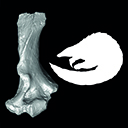
A pangolin (Manidae, Pholidota, Mammalia) from the French Quercy phosphorites (Pech du Fraysse, Saint-Projet, Tarn-et-Garonne, late Oligocene, MP 28)
Published online: 14/09/2015
Keywords:
Oligocene; Pangolin; Pech du Fraysse; Quercy Phosphorites
https://doi.org/10.18563/pv.39.2.e4
Abstract
Pangolins have never shown a high taxic diversity and their fossil record is scarce. We report here the first discovery of a partial humerus from late Oligocene deposits in Pech du Fraysse (MP28, France). The new specimen from Pech du Fraysse is described and compared to various extant and extinct species of pangolins. It shows a suite of morphological features very similar to the humeri discovered in Saint-André (MP 26), Solnhofen (Burdigalien), and Saulcet (Aquitanian), attributed here to Necromanis franconica. The description of the specimen from Pech du Fraysse allowed us to discuss the systematics of Paleogene and Neogene pholidotans. The differences between PFY 4051 and N. franconica on the one side, and N. quercyi on the other side, might be sufficiently important to justify a generic distinction. A comparison with extant species showed that N. franconica was likely terrestrial and fossorial based on its humeral morphology.
PV article infos
Published in Vol.39-2 (2015)
|
PDF
|

|
Fossil snakes from the Palaeocene of Sao José de Itaborai, Brazil.Part 1 Madtsoiidae, Aniliidae.
Published online: 15/12/1998
Keywords:
Aniliidae s.l.; Brazil; Coniophis; Hoffstetterella; Madtsoia; Madtsoiidae; middle Palaeocene; New taxa; Snakes
https://doi.org/10.18563/pv.27.3-4.109-144
Abstract
The middle Palaeocene of São José de Itaboraí (State of Rio de Janeiro, Brazil) has yielded a very rich and diverse snake fauna which includes Madtsoiidae, Aniliidae s.l., Boidae, Tropidophiidae s.l., Booidea incertae sedis, and Russellophiidae. The present article (part I) deals with Madtsoiidae and Aniliidae s.l. Madtsoiidae are represented by many vertebrae and a few skull bones. They comprise one new species assigned to the genus Madtsoia (M. camposi sp. nov.). However, the definition of the genus Madtsoia is unsatisfactory and the generic allocation might be provisional. A few elements, vertebrae only, belong to the Aniliidae s. l. Two taxa are referred to this latter group: Coniophis cf. C. precedens and Hoffstetterella brasiliensis gen. et sp. nov. The forthcoming part II will deal with Boidae.
PV article infos
Published in Vol. 27, Fasc. 3-4 (1998)
|
PDF
|

|
New murids and gerbillids (Rodentia, Mammalia) from Pliocene Siwalik sediments of India.
Published online: 15/12/1997
Keywords:
Dental morphology; evolution; new species of murids and gerbillids; phylogenetic relationships; Systematics
https://doi.org/10.18563/pv.26.1-4.129-165
Abstract
Murids and gerbillids (Rodentia, Mammalia) recovered from four Upper Siwalik localities; Moginand (around 3.5-4.5 m.y.), Kanthro (around 2.5 m.y.), Ghaggar (around 2 m.y.) and Nadah (around 1.8-2 m.y.) are described herein. A comparison of Mus linnaeusi sp. nov. reveals its close relationship towards the house mouse Mus musculus. In contradiction to earlier proposals that Golunda migrated to the Indian subcontinent from Africa sometime during Late Pliocene, it is suggested here that Golunda (in the form of Golunda tatroticus sp. nov.) evolved from Parapelomys robertsí of Late Miocene deposits of Siwaliks. Golunda tatroticus sp. nov. exhibits a progressive relationship to the extant Indian Bush Rat Golunda ellioti through Golunda kelleri and Golunda sp. Tatera pinjoricus sp. nov. is considered here to be a link between the extinct Abudhabia kabulense and the extant Tatera indica.
PV article infos
Published in Vol. 26, Fasc. 1-4 (1997)
|
PDF
|

|
Analyse d'ouvrage: “M. ARSENAULT, H. LELIÈVRE & P. JANVIER (Eds.): Etudes sur les vertébrés inférieurs — VII e Symposium International, Parc de Miguasha, Québec, 9- 22 Juin 1991 (1994)”
Published online: 18/03/1996
Keywords:
Book review
https://doi.org/10.18563/pv.25.1.51-53
Abstract
Etude sur les vertébrés inférieurs (VIIe Symposium International, Parc de Miguasha, Québec, 9-22 Juin 1991), édité par Marius ARSENAULT, Hervé LELlÈVRE & Philippe JANVIER, 1994. Bulletin du Muséum National d'Histoire Naturelle, Paris, 4e Série, T. 17, Section C, n° 1-4, 529 p.
Ce volume spécial du Bulletin du Muséum réunit les actes du congrès international sur les Vertébrés inférieurs qui s'est tenu au Québec en 1991.
PV article infos
Published in Vol. 25, Fasc. 1 (1996)
|
PDF
|

|
New records of terrestrial Mammals from the upper Eocene Qasr el Sagha Formation, Fayum Depression, Egypt
Published online: 16/12/1996
Keywords:
Egypt; Eocene; Fossil mammals; Qasr el Sagha Formation
https://doi.org/10.18563/pv.25.2-4.175-192
Abstract
New records of terrestrial mammals from the Qasr el Sagha Formation, Fayum Depression, Egypt are reported, and the stratigraphic occurrences of these fossils noted. These include additional specimens of Moeritheríum, Barytherium, and anthracotheres, as well as the oldest record of a hyracoid in the Fayum.These Eocene mammals occur almost exclusively in the alluvial deposits of the Dir Abu Lifa Member of the Qasr el Sagha Formation and show close affinities to the faunas from the lower sequence of the Jebel Qatrani Formation. There is no evidence of a more marked faunal discontinuity between the Qasr el Sagha and Jebel Qatrani Formations than there is across any of the three major breaks in sedimentation that exist within the Jebel Qatrani Formation. The faunal similarities between fossils of the lower sequence of the Jebel Qatrani Formation and of the upper part of the Qasr el Sagha Formation is consistent with recent paleomagnetic dating that suggests that these rocks differ in age by only one to two million years.
PV article infos
Published in Vol. 25, Fasc. 2-4 (1996)
|
PDF
|

|
Les pantolestidés (Mammalia, Pantolesta) de l'Eocène inférieur de Prémontré (Aisne, France).
Published online: 30/07/2001
Keywords:
France; Mammals; Pantolestids; Ypresian
https://doi.org/10.18563/pv.30.1-2.11-35
Abstract
Study of pantolestid mammals from the late Ypresian locality of Prémontré (reference level MP 10) allows the recognition of three genera: Palaeosinopa. Pantolestes and Premontrelestes n. gen. Pantolestes, up to now only recorded from North America, is represented by P. sabatieri n. sp. Premontrelestes n. gen., represented by the type species P. duchaussoisi n. sp., is compared with Pantolestes and Buxolestes. The latter, known from middle Eocene sites in Europe, has not been recognized at Prémontré. Two other taxa, the first of which is close to Pantolestes and the second of Premontrelestes n. gen. are left in open nomenclature.
PV article infos
Published in Vol. 30, Fasc. 1-2 (2001)
|
PDF
|

|
Mammals and stratigraphy : the Paleocene of Europe
Published online: 01/12/1982
Keywords:
Europe; Mammalia; Mammalian biochronology; Paléogène; Stratigraphy
https://doi.org/10.18563/pv.12.ext
Abstract
The mammalian faunas of the Paleogene of Europe and their localities are reviewed with comments on problems of European stratigraphy (epoch, stage and substage limits) and on the possibilities of faunal migrations. Radiometric dating is discussed. A stratigraphic scale for the Paleogene is presented, as well as a refined system of sequential faunal levels.
PV article infos
Published in Vol. 12, Ext (1982)
|
PDF
|

|
Rana (Amphibia : Ranidae) from the upper eocene (MP17a) Hordle Cliff locality, Hampshire, England.
Published online: 15/06/1999
Keywords:
Amphibia; England; Rana; Ranidae; Upper Eocene
https://doi.org/10.18563/pv.28.1.47-51
Abstract
An ilium from the Upper Eocene (MP l7a) of Hordle, England, represents the first report of Rana from the Eocene of Britain. The ilium is similar to those of the water frog (Rana [ridibunda]) species group.
PV article infos
Published in Vol. 28, Fasc. 1 (1999)
|
PDF
|

|
Les Pseudosciuridae (Mammalia, Rodentia) de l'Eocène moyen de Bouxwiller, Egerkingen et Lissieu.
Published online: 30/10/1969
Keywords:
Bouxwiller; cranium; Egerkingen; Middle Eocene; Rodents
https://doi.org/10.18563/pv.3.2.27-64
Abstract
The description of new material from three classic middle Eocene localities of western Europe permits the addition of details to the systematics of primitive Pseudosciurids. The cranial anatomy of Protadelomys cartieri (STEHLIN and SCHAUB) from Egerkingen is described here and compared to that of the Adelomyines from the late Eocene, until now the only ones known. The morphologic and biometric study of the dentition of P. cartieri compared to that of P. alsaticus n. sp. from Bouxwiller and P. Iugdunensis n. sp. from Lissieu, forms respectively older and younger than P. cartieri, permits the evolutionary tendencies of the group to be demonstrated and shows that notable differences in age exist between these localities. This ensemble of forms can constitute a valuable guide lineage in the establishment of a fine stratigraphy of the period. Other less well known lineages are present at Egerkingen along with P. cartieri. They can be related to genera that have been noted int he late Eocene. In conclusion, a criticism of recent zonation proposals, made by divers authors, completes this article.
PV article infos
Published in Vol. 03, Fasc. 2 (1969)
|
PDF
|
|
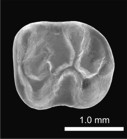
A new and primitive species of Protophiomys (Rodentia, Hystricognathi) from the late middle Eocene of Djebel el Kébar, Central Tunisia
Published online: 02/06/2014
Keywords:
Adaptive radiation; Bartonian; Dental morphology; North Africa; Paleobiogeography
https://doi.org/10.18563/pv.38.1.e2
Abstract
Based on fossil discoveries and phylogenetic studies, an Eocene Asian origin for hystricognathous rodents and anthropoid primates has gained strong support in recent years. The two groups then invaded both Africa and South America, which promoted their evolutionary success. However, the fossil record has so far failed to constrain the nature and precise timing of these pivotal dispersal events. In Africa, given the apparent absence of hystricognaths and anthropoids in early to early middle Eocene localities, it is suggested that these mammal groups dispersed from Asia to Africa sometime during the middle Eocene. In this paper, we report the discovery of several isolated teeth of a rodent from a new vertebrate locality situated in central Tunisia (Djebel el Kébar, KEB-1), dating from the late middle Eocene (Bartonian, ~39.5 Myr). These fossils document a diminutive new species of Protophiomys (P. tunisiensis nov. sp.), a basal genus of hystricognathous rodents which is well known from several North African mammalian-bearing localities of the end of the Eocene. The teeth of P. tunisiensis display a suite of anatomical details comparable with those observed in the other species of the genus, but with a lesser degree of development. Such an apparent primitive evolutionary stage is corroborated by the greater antiquity of this Tunisian species. P. tunisiensis nov. sp. is so far the most ancient representative of hystricognaths in Africa. However, it can be expected that hystricognaths were already present on that landmass given the new data on early caviomorphs recently reported from South America (at ~41 Myr). The arrival of hystricognaths in Africa from South Asia certainly predates the depositional period of the Kébar sediments, but perhaps not by much time.
PV article infos
Published in Vol.38-1 (2014)
|
PDF
|
|
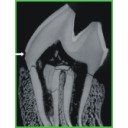
Enamel hypoplasia on rhinocerotoid teeth: Does CT-scan imaging detect the defects better than the naked eye?
Published online: 03/01/2022
Keywords:
fossil teeth; method; micro-CT imaging; Rhinocerotoidea
https://doi.org/10.18563/pv.45.1.e2
Abstract
Micro-CT imaging is an increasingly popular method in paleontology giving access to internal structures with a high resolution and without destroying precious specimens. However, its potential for the study of hypoplasia defects has only recently been investigated. Here, we propose a preliminary study to test whether hypoplastic defects can be detected with micro-CT (μCT) scan and we assess the costs and benefits of using this method instead of naked eye. To do so, we studied 13 fossil rhinocerotid teeth bearing hypoplasia from Béon 1 (late early Miocene, Southwestern France) as positive control and 11 teeth of the amynodontid Cadurcotherium (Oligocene, Phosphorites du Quercy, Southwestern France), for which enamel was partly or totally obscured by cement. We showed that all macroscopically-spotted defects were retrieved on 3D reconstructions and selected virtual slices. We also detected additional defects using μCT scan compared to naked eye identification. The number of defects detected using μCT was greater in the Cadurcotherium dataset (paired-sample Wilcoxon test, p-value = 0.02724) but not for our control sample (paired-sample Wilcoxon test, p-value = 0.1171). Moreover, it allowed for measuring width and depth of the defects on virtual slices (sometimes linked to stress duration and severity, respectively), which we could not do macroscopically. As μCT imaging is both expensive and time consuming while not drastically improving the results, we recommend a moderate and thoughtful use of this method for hypoplasia investigations, restricted for instance to teeth for which enamel surface is obscured (presence of cement, uncomplete preparation, or unerupted germs).
PV article infos
Published in 45-1 (2022)
|
PDF
S.I. Data
|
|
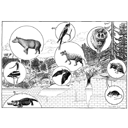
Essai de reconstitution d'un paysage du Quercy vers -35 Ma. (Esquisse de Christian Pondeville, 1977).
Published online: 15/09/1978
Keywords:
Landscape reconstruction; Quercy Phosphorites
https://doi.org/10.18563/pv.8.2-4.landscape
Abstract
Le Quercy est aujourd'hui un vaste plateau calcaire, parcouru par un réseau karstique actif, pro· fondément entaillé par des vallées aux falaises abruptes, comme celles du Lot ou du Célé. Sur un sol peu épais domine la forêt de chênes, accompagnés de cornouillers, érables, genévriers. La faune est pauvre, peu diverse, et les nombreux chasseurs se satisfont de gibier d'élevage ...
Il y a trente-cinq millions d'années environ, le paysage était bien différent. La période de l'Eocène supérieur, qui s'achevait, avait été chaude et humide, si l'on se réfère à la fois aux paléotempératures (calculées à partir de sédiments marins extra-européens) et aux restes fossilisés de végétaux typiquement tropicaux.
Le Causse du Quercy devait être un plateau très disséqué par la karstification, à surface lapiazée creusée de gouffres en rapide évolution interne, et couvert d'un sol assez épais. Une forêt tropicale humide, avec notamment des Myricacées et des gymnospermes, recouvrait l'ensemble du pays, à peine interrompue au niveau des rares points d'eaux situés dans les bas-fonds. Dans ce cadre vivait une faune considérablement différente de la maigre faune actuelle. Si nous pouvons l'imaginer, c'est grâce aux cadavres des animaux entraînés dans les cavités par les eaux courantes ou les prédateurs, ou bien logeant et mourant dans les milieux souterrains. Nombre de ces restes, fossilisés, sont parvenus jusqu'à nous et sont aujourd'hui l'objet d'étude.
View editorial
Published in Vol. 08, Fasc. 2-4 (1978)
|
PDF
|

|
La Poche à phosphate de Ste-Neboule (Lot) et sa faune de vertébres du Ludien Supérieur. 3- Chéloniens
Published online: 25/09/1978
Keywords:
Eocene; Quercy Phosphorites
https://doi.org/10.18563/pv.8.2-4.181-184
Abstract
The few remains recently collected at Ste Néboule (upper Eocene) belong to three genera: the Testudinid Ergilemys, of which it is the oldest occurence in Western Europa, probably Palaeochelys and an unpublished genus, which is peculiar to the Phosphorites du Quercy. Some statements are made on the chelonian fauna as a whole in that région. After the study of some characters proper to the genus Ergilemys, some remarks are made concerning its antecedents and descendants.
PV article infos
Published in Vol. 08, Fasc. 2-4 (1978)
|
PDF
|

|
La poche à phosphate de Ste-Néboule (Lot) et sa faune de vertébres du Ludien Supérieur. 2- Amphibiens. Etude Preliminaire
Published online: 25/09/1978
Keywords:
Eocene; Quercy Phosphorites
https://doi.org/10.18563/pv.8.2-4.175-179
Abstract
The Caudata are known by two Salamandridae ; one of them is attributed to the genus Megalotriton. The Pelobatidae form the major part of the Anura ; a few bones indicate also the presence of Neobatrachia.
PV article infos
Published in Vol. 08, Fasc. 2-4 (1978)
|
PDF
|

|
Une faune du niveau d'Egerkinger (MP 14; Bartonien inférieur) dans les phosphorites du Quercy (Sud de la France)
Published online: 18/12/1990
Keywords:
Biochronology; Early Bartonian; Eocene; evolution; Mammals; New taxa; Quercy
https://doi.org/10.18563/pv.20.1.1-32
Abstract
The Laprade fauna is chronologically situated between those from Egerkingen and Lissieu and consequently, is close to the MP 14 reference-level of the European mammalian biochronological scale (Symposium of Mainz, 1987).
This new fauna is presently the oldest known in the Quercy phosphorites, formerly the Le Bretou fauna (MP 16) was considered as the oldest one. The Laprade fauna includes 21 species which belong in 7 mammalian orders (Marsupialia: Amphiperatherium bastbergense, Amphiperatherium goethei; Apatotheria: Heterohyus (Gervaisyus) pygmaeus nov. subgen., nov. sp.; Lipotyphla: Saturninia cf. mamertensis, Saturninia cf. intermedia; Chiroptera: Vespertiliavus lapradei nov. sp.; Rodentia: Protadelomys cf. lugdunensis, Elfomys nov. sp.; Primates: Nannopithex cf. filholi, cf. Pseudoloris or Pivetonia; Perissodactyla: ?Palaeotherium ?castrense, small-sized Palaeotherium sp., Plagiolophus sp., Anchilophus sp.; Artiodactyla: Dichobune cf. robertiana, Mouillacitherium cartieri, Tapirulus cf. depereti, Mixtotherium priscum, Pseudamphimeryx schlosseri, and Artiodactyla indet). Sixteen of these species are mentioned for the first time from the Quercy faunas.
The recognition of a new apatemyid, Heterohyus (Gervaisyus) pygmaeus nov. subgen., nov. sp., attests to an early origin of a lineage known in the Late Eocene. The emballonurid bat Vespertiliavus lapradei nov. sp. is presently the earliest record of this genus and family. This Auversian fauna leads to discuss the age of taxa showing archaic features. These taxa were defined on specimens collected in the Quercy during the last century and have never been found in the Quercy localities recently investigated. This fauna bears also evidence of a karstic filling episode older than those previously dated by fossils in the Quercy Jurassic.
PV article infos
Published in Vol. 20, Fasc. 1 (1990)
|
PDF
|

|
Pairomys et Ectropomys : la fin d'une ambiguïté ; mise au point sur les Oltinomyinae et Remyinae (Rodenia, Theridomyidae).
Published online: 20/05/1994
Keywords:
PHYLOGENY; taxonomy; Theridomyidae; Upper Eocene
https://doi.org/10.18563/pv.23.1-4.119-152
Abstract
The description of new material of the Upper Eoœne of France, Southem Germany and Spain together with the restudy of the material described by Thaler (1966b) as Pairomys allows to confirm the validity of the genus Ectropomys up to know controversally discussed. As a consequence the subfamily Remyinae and Oltinomyinae can be defined precisely. The study of the dental characters shows that the Remyinae in fact belong to the Theridomyidae and represent a derived evolutionary unit within this family. The Oltinomyinae together with the Theridomyinae and Issiodoromyinae very probably form a monophyletic unit.
PV article infos
Published in Vol. 23, Fasc. 1-4 (1994)
|
PDF
|

|
Contributions à l'étude du gisement Miocène supérieur de Montredon (Hérault). Les grands mammifères. 5 - Les périssodactyles Equidae
Published online: 15/11/1988
Keywords:
Equidae; Hipparion; Late Vallesian; Mammalia; Montredon; Perissodactyla
https://doi.org/10.18563/pv.18.ext.65-96
Abstract
Revision of the hipparion material from Montredon, including newly excavated and other unpublished specimens brings evidence of specific heterogeneity.
A fragmentary very small MC III seems very close to H. macedonicum from the upper Vallesian of Ravin de la Pluie, Greece. In that same site was also found a large hipparion.
Most of the Montredon material is referred to H. depereti. This species associates characters usually found in Vallesian hipparions (highly plicated upper cheek teeth, deep vestíbular grooves on the lower cheek teeth, robust metapodials) with characters more frequent in Turolian forms (middle size, lack of confluence in the upper premolar fossettes, lack of ectostylids on the adult lower cheek teeth, well developped keel on the MC III, facette for the 2nd cuneiform present on all MT III). H. depereti shares some of these characters with the Spanish and Portuguese hipparions transítional between the Vallesian and the Turolian (Masia del Barbo, Azambujeira) but is not identícal to any of them. The upper Vallesian hipparion material from Diavata, Greece, probably belongs to H. depereti but not the large hipparion rests from Ravin de la Pluie.
Thus, Montredon and Ravin de la Pluie may well share the same small species, H. macedonicum, but they differ in the associated one: middle-sized H. depereti at Montredon, large-sized H. primigenium at Ravin de la Pluie. Both sites, however, give evidence of small hipparions during the Vallesian, coexisting with other larger species.
The present paper also proposes an adaptation of the Kiesewalter's indices that calculates the height at the withers using the metapodial length, and discusses indices proposed by Gromova and by Sen et al. to express the relative development of the metapodial keel.
PV article infos
Published in Vol. 18, Ext (1988)
|
PDF
|