
Miocene Bovidae (Mammalia) of the Siwaliks: Hypsodontinae and Bovinae
Pterosaurs from Coahuila
Paléoenvironnement des mammifères des Gour Lazib
Les sélaciens du Miocène de la région de Montpellier
Contribution à l'étude des genres Gliravus et Microparamys.
Muridae du Pliocène supérieur d'Espagne et du midi de la France.
Eocene (57) , Quercy Phosphorites (38) , Systematics (32) , Rodents (29) , Mammalia (27) , Rodentia (25) , Miocene (25)

|
Analyse d'ouvrage : A.J.Sutcliffe. On the track of Ice Age mammalsJacques MichauxPublished online: 30/12/1985Keywords: Book review https://doi.org/10.18563/pv.15.4.270 Abstract On the Track of Ice Age Mammals justifie pleinement son titre car l'auteur, Anthony J. Sutcliffe, apporte au lecteur faits et interprétations qui l'amèneront à s'intéresser encore plus au passé récent et à l'avenir de son environnement et à la question de l'impact de l'homme sur la nature. Après les chapitres qui présentent les temps glaciaires et les divers témoignages qui nous en sont parvenus, les cinquième et sixième apportent les informations nécessaires à la compréhension des résultats que nous donnent les chercheurs: principes, moyens d'étude et limites des méthodes, difficultés de l'intégration des données dans un cadre stratigraphique, variabilité des signaux climatiques, variabilité de leur intensité selon l'endroit par rapport au centre de la glaciation, complications liées à la qualité inégale de l'enregistrement géologique, en mer et sur le continent. PV article infos Published in Vol. 15, Fasc. 4 (1985) |
|

|
Un nouveau type de coquille d'oeuf présumé Dinosaurien dans la Campanien et le Maestrichtien continental de Provence.Philippe KerourioPublished online: 04/10/1982Keywords: Campanian/Maastrichtian; eggshell microstructure; Provence https://doi.org/10.18563/pv.12.4.141-147 Abstract The discovery of eggshells of ornithoid type is signaled for the first time in the continental Campanian and Maastrichtían of Provence. The taxonomie relationship of these eggshells and their interest in the biostratigraphical study of Upper Cretaceous of Provence are discussed. PV article infos Published in Vol. 12, Fasc. 4 (1982) |
|
|
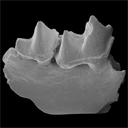
First Neogene Otonycteris (Chiroptera: Vespertilionidae) from Ukraine: its biostratigraphic and paleogeographic significance.Valentina V. RosinaPublished online: 19/03/2015Keywords: bats; East Europe; Gritsev; Late Miocene; Mammalia https://doi.org/10.18563/pv.39.1.e2 Abstract A new species, Otonycteris rummeli nov. sp., is described from the Late Miocene site Gritsev (MN 9) in the Ukraine. Otonycteris rummeli nov. sp. differs from those of most vespertilionids, except recent Otonycteris, Antrozous and Early Miocene Karstala silva, in having a well-developed entocingulid at the foot of the trigonid valley in the lower molars. The morphological resemblance of Otonycteris, Antrozous and Karstala is apparently a case of convergence in the evolution of the Old and New Worlds bat faunas. From at least the Middle Miocene the range of Otonycteris distribution spread to the whole of Central Europe and such a situation continued during the whole Late Miocene. This indicates a more arid climate in Europe during the Upper Miocene compared to the Quaternary. The reduction of the distribution range of Otonycteris and its extinction in most of the territory of Europe could have been caused by the global climatic cooling and increasing glacial cycle amplitude during the onset of the Quaternary. PV article infos Published in Vol.39-1 (2015) |
|

|
An unusual cranial fossil of the giant lower Pliocene shrew (Paranourosorex gigas Rzebik-Kowalska, 1975) from Podlesice, PolandDavid L. Harrison and Barbara Rzebik-Kowalska
Published online: 29/10/1991 |
|

|
Les Ischyrictis de la transition Vindobonien-VallésienMiquel Crusafont i PairóPublished online: 15/09/1972Keywords: Ischyrictis; Mustelidae https://doi.org/10.18563/pv.5.5.253-260 Abstract Le groupe des Mustélides « Ischyrictoïdes » développe des tendances évolutives qu’engendrent des formes de Carnassiers prédateurs robustes et de grande taille. C’est une évolution comparable à celle que l’on trouve chez Plesiogulo, qui, lui, a une origine énigmatique (Petter, 1963). Chez les Mustélides on peut signaler deux lignées assez nettes : celle du sous-genre nominal des Laphyctis, plus conservatrice, plus mustéliforme, renfermant les espèces Ischyrictis (Laphyctis) mustelinus VIRET et L. zibethoides BLAINVILLE ; celle de type félinoïde caractérisée par L. Ginsburg (1961) avec la forme type Ischyrictis (Hoplicitis) florancei du Vindobonien inférieur de Pontlevoy-Thenay et I. helbingi VIRET, 1951 du Vindobonien supérieur de la Grive Saint-Alban. De plus rappelons que I. vorax DEHM et I. comitans DEHM du Burdigalien de Wintershof-West sont sans rapport avec les espèces du Miocène supérieur (Ginsburg, o.c.). PV article infos Published in Vol. 05, Fasc. 5 (1972) |
|

|
La poche à phosphate de Ste-Neboule (Lot) et sa faune de vertébres du Ludien Supérieur. 1 La poche et son remplissageBernard GèzePublished online: 15/09/1978Keywords: Eocene; Quercy Phosphorites https://doi.org/10.18563/pv.8.2-4.171-173 Abstract La poche de Ste-Néboule, commune de Béduer (Lot), 15 km environ à l'WSW de Figeac, fait partie du groupe le plus septentrional des gouffres creusés par les ruissellements du Paléogène dans les calcaires jurassiques de la bordure sud-ouest du Massif Central et qui furent comblés à la même époque par des argiles sidérolithiques accompagnées de phosphate de chaux concrétionné ainsi que des restes de la célèbre faune dite «des phosphorites du Quercy» . PV article infos Published in Vol. 08, Fasc. 2-4 (1978) |
|

|
The endocranial cast and encephalization quotient of Ptilodus (Multituberculata, Mammalia)David W. Krause
Published online: 11/02/1993 |
|

|
Analyse d'ouvrage : "Mammoths, mastodonts & elephants. biology, behavior and the fossil record. Gary HAYNES, 1992. Cambridge University Press, New York, xii + 413 p., ISBN 0-521-38435-4"Jean-Loup WelcommePublished online: 11/02/1993Keywords: Elephants; Mammoths; Mastodonts https://doi.org/10.18563/pv.22.2-3.137-139 Abstract L'ouvrage est divisé en trois grandes parties traitant successivement: I. l'anatomie ("Proboscidean flesh and bones"), en abordant la taxonomie, l'allure générale et l'éco-éthologie des proboscidiens actuels et fossiles; II. les causes de mortalité collective naturelle et provoquée chez les actuels; III. les documents fossiles et l'extinction des formes anciennes d'Amérique du Nord. PV article infos Published in Vol. 22, Fasc. 2-3 (1993) |
|

|
Book review : Dr. Robert R. REISZ, 1986. Encyclopedia of Paleoherpetology, Volume: 17A: Pelycosauria.Jean-Yves CrochetPublished online: 20/06/1987Keywords: Book review; Paleoherpetology https://doi.org/10.18563/pv.17.2.75-76 Abstract L’Encyclopedia of Paleoherpetology, Part 17A : Pelycosauria de Robert R. Reisz (1986) offre une synthèse complète des synapsides les plus primitifs et les plus anciens, essentiels pour comprendre l’évolution précoce de ce groupe majeur de vertébrés. L’ouvrage commence par un historique, suivi d’une analyse ostéologique détaillée du crâne, du squelette axial et appendiculaire. PV article infos Published in Vol. 17, Fasc. 2 (1987) |
|
