
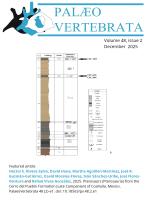
Miocene Bovidae (Mammalia) of the Siwaliks: Hypsodontinae and Bovinae
Pterosaurs from Coahuila
Paléoenvironnement des mammifères des Gour Lazib
Les sélaciens du Miocène de la région de Montpellier
Contribution à l'étude des genres Gliravus et Microparamys.
Muridae du Pliocène supérieur d'Espagne et du midi de la France.
Eocene (57) , Quercy Phosphorites (38) , Systematics (32) , Rodents (29) , Mammalia (27) , Rodentia (25) , Miocene (25)

|
Paleobiology of Messel ErinaceomorphsGerhard StorchPublished online: 16/12/1996Keywords: Erinaceomorpha; Germany; Grube Messel; Lipotyphla; Middle Eocene; Paleobiology https://doi.org/10.18563/pv.25.2-4.215-224 Abstract Three erinaceomorph species are known from the early Middle Eocene of Grube Messel near Darmstadt, Germany, which are referred to the family Amphilemuridae. Pholidocercus hassiacus, Macrocranion tupaiodon, and Macrocranion tenerum showed extraordinary adaptations to their different life strategies, and several of their specializations are unknown among living insectivores. Pholídocercus was a well-defended robust animal with an opportunistic feeding strategy. Macrocraníon zupaiodon was a slender forest floor-dweller with saltatorial specializations to escape from predators; fishes were the preferred component of its omnivorous diet. Macrocranion tenerum exhibited a combination of both survival strategies, extremely elongated hind limbs for rapid and even ricochetal flight and a spiny exterior as an effective protective device; it was probably specialized for feeding on ants. Thus, closely related, omnivorous-insectivorous forest floor-dwellers could exploit the Messel ecosystem. PV article infos Published in Vol. 25, Fasc. 2-4 (1996) |
|

|
Historical and new perspectives on the parataxonomyof fossil eggs.Monique Vianey-Liaud
Published online: 15/12/2003 |
|

|
The microfauna of the Djebel Qafze CaveG. HaasPublished online: 15/09/1972Keywords: Micromammals; Rodents https://doi.org/10.18563/pv.5.5.261-270 Abstract This study examines the microfauna from Djebel Qafze Cave, focusing on mammalian remains, with Microtus guentheri as the dominant species and a notable absence of Cricetinae (hamsters). The richest layers (XVIa, XVII, XVIII) suggest accumulation by raptors, particularly owls, given the high presence of nocturnal species like voles and shrews. Two significant species, Arvicanthis cf. ectos and the newly described Rattus (? Mastomys) nazarensis, are highlighted. Reptiles (gekkos, Ophisaurus) and birds are also present, while hedgehogs and lagomorphs are absent. The findings underscore the role of avian predators in fossil deposition and refine the chronology of regional Pleistocene fauna. PV article infos Published in Vol. 05, Fasc. 5 (1972) |
|

|
Fossil mammals and the age of the changxindian formation, Northeastern ChinaSpencer G. LucasPublished online: 16/12/1996Keywords: Changxindian Formation; China; Eocene; Fossil mammals https://doi.org/10.18563/pv.25.2-4.133-140 Abstract Re-evaluation of the small collection of mammal fossils from the Changxindian Formation near Beijing, China indicates the following taxa are present: Eutheria, Hypsimilus beifingensis, cf. Miacis sp., Anthracotheriidae and Forstercooperia grandis. The presence of Forstercooperia grandis indicates an Irdinmanhan age and does not support previous assignment of a Sharamurunian age to the Changxindian Formation. PV article infos Published in Vol. 25, Fasc. 2-4 (1996) |
|

|
Découverte d'un gisement de micromammifères d'âge Pliocène dans le bassin de Constantine (Algérie), présence d'un muridé nouveau : Paraethomys Athmeniae n.sp.Brigitte Coiffait and Philippe-Emmanuel CoiffaitPublished online: 16/05/1981Keywords: Algeria; Constantine; Micromammals; Muridae; Pliocene https://doi.org/10.18563/pv.11.1.1-15 Abstract The study of that locality allowed the description of a new Muridae : Paraethomys athmeniae n. sp. It reveals the existence of new rodent for Algeria : first, a Sciuridae, Atlantoxerus cf. rhodius, and second, a Gliridae, Eliomys truci. So, that work shows the presence of the genus Eliomys in North Africa before the middle of Pleistocene. Lastly, Paraethomys cf. anomalus gives an exact datation of that bed. PV article infos Published in Vol. 11, Fasc. 1 (1981) |
|

|
Rongeurs Miocènes dans le Valles-Penedes 2 : Les rongeurs de Castell de BarberaJean-Pierre Aguilar, Jordi Agusti
Published online: 20/04/1979 |
|
|
Angolabatis nom. nov.,a replacement name for the Cretaceous genus Angolaia Antunes & Cappetta, 2002 (Chondrichthyes: Rajiformes), a preoccupied name.Miguel T. Antunes
Published online: 15/10/2006 |
|
|
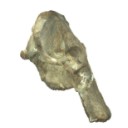
Morphological description and identification of an extraordinary new elephant cranium from the early Pliocene of Ileret, Kenya
|
|
|
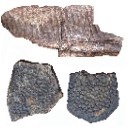
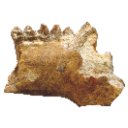
Terrestrial vertebrate paleocommunities from the Cerro del Pueblo Formation (Late Cretaceous; Late Campanian) at Las Aguilas, Coahuila, MexicoHéctor E. Rivera-Sylva
Published online: 16/07/2019 |
|
|
The new Algerian locality of Bir el Ater 3: validity of Libycosaurus algeriensis (Mammalia, Hippopotamoidea) and the age of the Nementcha FormationFabrice Lihoreau
Published online: 10/06/2015 |
|

|
La poche à phosphate de Ste-Néboule (Lot) et sa faune de vertebres du Ludien superieur. 14 - Conclusions généralesJean-Louis HartenbergerPublished online: 25/09/1978Keywords: Eocene; Quercy Phosphorites https://doi.org/10.18563/pv.8.2-4.319-326 Abstract Le matériel provenant de nouvelles fouilles dans les phosphorites du Quercy, soumis aux divers spécialistes, a conduit à la soutenance de plusieurs thèses d'état: sur les rongeurs (Hartenberger, Vianey-Liaud), les Chiroptères et Insectivores (Sigé), les Artiodactyles (Sudre), les Squamates (Rage) et, en partie, les Chéloniens (De Broin). Chacun dans son domaine, à côté des conclusions d'ordre évolutif, paléogéographique ou paléoécologique, a pu établir des successions stratigraphiques des gisements du Quercy qui se sont révélées largement concordantes. Ainsi la succession des faunes du Quercy est actuellement l'une des mieux établies. Dans ce contexte, les différents spécialistes ont décidé de conjuguer leurs efforts dans l'étude monographique de plusieurs gisements repérés le long de cette échelle, afin de rassembler l'information paléontologique sur des faunes bien précises et de tenter d'obtenir des indications d'ordre taphonomique. PV article infos Published in Vol. 08, Fasc. 2-4 (1978) |
|

|
Sur les empreintes de pas des gros mammifères de l'Eocène supérieur de Garrigues-ste-Eulalie (Gard)Paul EllenbergerPublished online: 01/10/1980Keywords: Eocene; Euzet; Footprints; Ichnofauna https://doi.org/10.18563/pv.9.ext.37-78 Abstract Is hereby described an impressive lchnoiauna belonging to the Lower to Middle Ludian of the Gard (S. France). The slab, already cleaned over a length of 18 m, is located near the top of the Potamides aporoschema lacustrine limestone (Lower Ludian, Euzet zone). It is therefore older than the Célas sandstone deposit, and still more than the Melanoides albigensis and M. acutus marly limestone corresponding to the Upper Levels of the Ludian stage. Although biostratigraphically older than the La Débruge and Montmartre zone, the biotope shows already a sampling of very tall Artiodactyles, Perissodactyles and Carnivorous. One of the most « majestic ›› Artiodactyles, Anopolotheriipus lavocati, nov., points out a huge size type. To mention also among the Ichnotypes described, 10, the big Perissodactyle Palaeotheriipus similimedius, nov., and the big Carnivorous Hyaenodontipus praedator, nov. PV article infos Published in Vol. 9, Ext (1980) |
|

|
Analysis of mammalian communities from the late Eocene and Oligocene of southern FranceSerge Legendre
Published online: 15/12/1986 |
|

|
A survey of Cretaceous tribosphenic mammals from middle Asia (Uzbekistan, Kazakhstan and Tajikistan), of their geological setting, age and faunal environmentLev A. Nessov, Denise Sigogneau-Russell and Donald E. RussellPublished online: 20/05/1994Keywords: Cretaceous; Environment; Middle Asia; Sharks; Tribosphenic mammals https://doi.org/10.18563/pv.23.1-4.51-92 Abstract This paper is an English concentrate of various Russian publications by the senior author presenting the mammaIian taxa from the Cretaceous (Albian through Santonian) of the region termed Middle Asia by Soviet geographers. The diagnoses are the unmodified, literal translation of the original version, but are followed with short complementary remarks; most of the species are illuslrated anew with SEM photographs, others are by normal photography. The fossiliferous formations are cited and arguments for their dating are given. Finally, the main vertebrate groups accompanying mammaIs are listed and the environment and climate at the time of deposition are suggested. In conclusion, an hypothesis on the origin and high diversity of tribosphenic mammals on the Cretaceous coastal plains of southwest Asia is proposed. In appendix the taxon Khuduklestes bohlini novo gen. novo sp. is formally defined. PV article infos Published in Vol. 23, Fasc. 1-4 (1994) |
|

|
Les artiodactyles du gisement yprésien terminal de Premontre (Aisne, France)Jean Sudre and Jorg ErfurtPublished online: 16/12/1996Keywords: Artiodactyls; France; Mammals; new species; Ypresian https://doi.org/10.18563/pv.25.2-4.391-414 Abstract The artiodactyls (Mammalia) from the latest Ypresian locality of Prémontré from the Paris Basin (niveau repère MP 10 in the lower Eocene of the Paris Basin) are described in this paper. Three species have been identified: 1) Diacodexis cf. varleti SUDRE et al., 1983; 2) a new species of Eurodexis ERFURT & SUDRE (E. russelli nov. sp.) defined after the revision of the species Messelobunodon? ceciliensis from the Lutetian beds of Geiseltal (Germany); and 3) Eurodexeinae indet., a probable ancestor of another form from the Geiseltal which was previously recorded as Homacodon? sp. (Erfurt 1993) and now named Parahexacodus germanicus. The two later forms are referred to the new subfamily Eurodexeinae (Erfurt & Sudre 1996). The analysis of these forms as weIl as comparative studies have led us to reconsider our previous conclusions regarding the content of the species Protodichobune oweni LEMOINE 1878 and some aspects of Ypresian diacodexid evolution. One can postulate that the divergence of E. russelli nov. sp. occurred during the first radiation of these primitive artiodactyls. Some other stem form with bunodont teeth such as Protodichobune and Aumelasia have also differentiated from Diacodexis. Like Eurodexis, these two genera persist during the middle Eocene. The absence of Protodichobune and Aumelasia at Prémontré is probably due to particular ecological conditions. PV article infos Published in Vol. 25, Fasc. 2-4 (1996) |
|

|
Mode de vie et affinités de Paschatherium (Condylarthra, Hyopsopontidae) d'après ses os du tarseMarc Godinot
Published online: 16/12/1996 |
|

|
Les poissons crétacés et tertiaires du bassin des Iullemmeden (République du Niger)Henri Cappetta
Published online: 15/09/1972 |
|

|
Fossil snakes from the Palaeocene of Sao José de Itaborai, Brazil, Part II. BoidaeJean-Claude Rage
Published online: 28/12/2001 |
|

|
Stratigraphy and Oligocene-Miocene mammalian biochronology of the Aktau Moutains, Dzhungarian Alatau Range, KazakhstanElena G. Kordikova
Published online: 16/12/1996 |
|

|
Contributions à l'étude des micromammifères du gisement Miocène supérieur de Montredon (Hérault). 4 - Les chiroptèresBernard SigéPublished online: 30/06/1982Keywords: Chiroptera; Hérault; Late Miocene; Micromammals; Montredon https://doi.org/10.18563/pv.12.3.133-140 Abstract The Montredon local fauna yielded very rare bats, represented by damaged isolated teeth. Only a few documents are available for this period of the European Neogene. ln this poor state of knowledge, the material represents three undetermined species, a supposed molossid and two vespertilionids. PV article infos Published in Vol. 12, Fasc. 3 (1982) |
|
